Senoia's Home Prices Depend on Which Senoia You're Buying Into
September 10, 2026
September 10, 2026
If you've spent any time comparing Senoia to other towns south of Atlanta, you've probably run into a contradiction. Pull up one portal and Senoia's median home price sits around $560,000. Check another the same week and you'll see a different number, a different pace, sometimes a swing of tens of thousands of dollars. Neither number is wrong. They're measuring two different markets that happen to share a zip code.
As of August 2026, Homes.com listed Senoia's median home price at $560,000, with an average sale price of $557,648 and homes spending a median of 55 days listed. That same month, Movoto put Senoia's median list price at $564,000, with homes sitting a median of 77 days on the market, flat compared to August 2025. Both numbers came from the same town, in the same month. They still landed more than three weeks apart on how long a home typically sits before it sells.
Then there's Zillow's home value index, which measures the estimated worth of every home in town, not just the ones that changed hands. For the year ending around mid-2026, that index put Senoia's average home value at $509,786, up 3 percent. That's a $50,000 gap between what's actually closing and what the typical home in Senoia is worth on paper.
The gap isn't a data error. It's a sample size problem dressed up as a market signal.
Senoia is a small town. The clearest illustration of just how small came in November 2025, when Redfin counted only 9 closed sales for the entire month and reported a median price of $540,000, a swing of more than 20 percent from the same month a year earlier. That kind of swing has nothing to do with the market suddenly cooling. It has everything to do with math. When only 9 homes close in a month, one large new-construction sale or one small historic cottage can move the median by tens of thousands of dollars in either direction. A town the size of Atlanta absorbs that noise across hundreds of transactions. Senoia can't.
The same logic explains the gap between the median-of-what-sold numbers (around $560,000) and Zillow's index-of-what's-typical number (around $510,000). Zillow's figure is weighted across the entire housing stock, including older homes in the historic core that rarely change hands. The median sale price only counts what actually closed, and lately what's closing skews toward new-construction subdivisions, which tend to be bigger, newer, and priced higher than the average existing home in town.
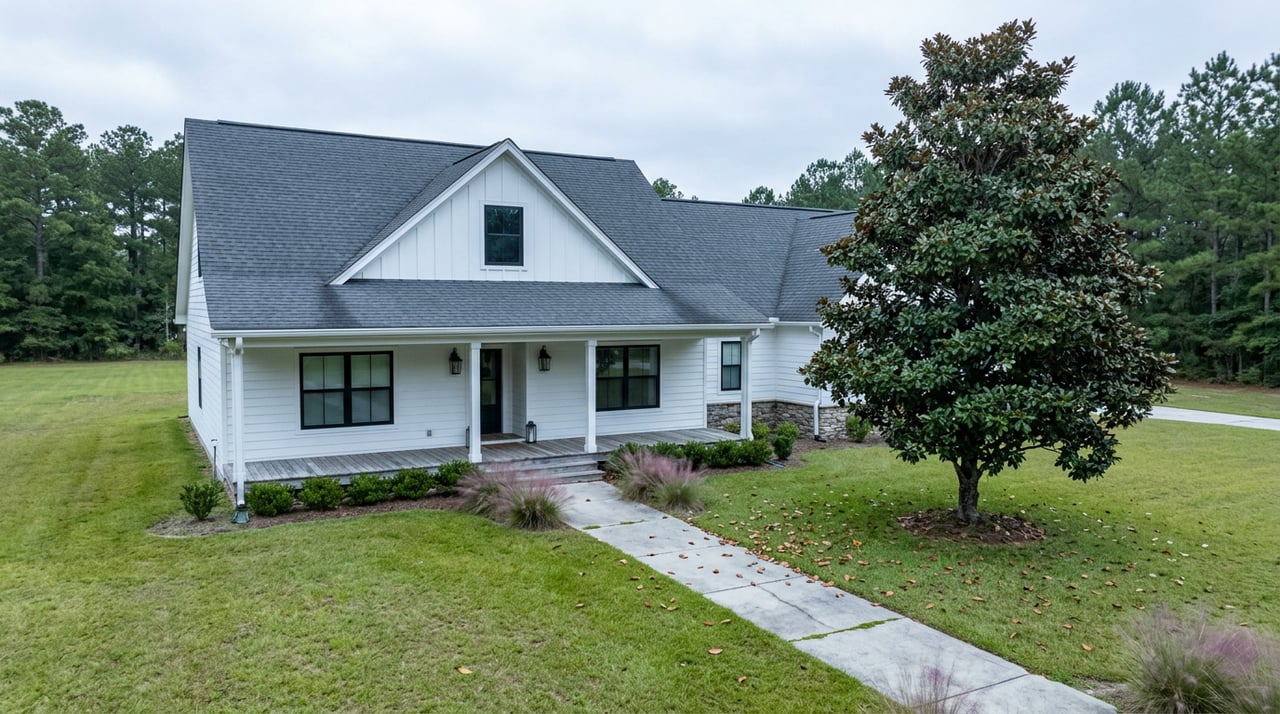
So when someone asks whether Senoia is expensive, the honest answer is: compared to which Senoia? The 1920s cottage four minutes from downtown and the four-bedroom farmhouse-style new build on an acre outside town are not competing for the same buyer, and they're not moving the market the same way.
That new-construction skew isn't incidental. It's the product of an active builder pipeline that's been running for years and shows no sign of slowing.
| Subdivision | Builder | What You're Buying |
|---|---|---|
| Heritage Pointe | D.R. Horton | Built out since 2006; newest phase runs roughly 2,900 to 3,700 square feet, 4 to 5 bedrooms |
| Graceton Farms | Jeff Lindsey Communities / DRB Homes | One-acre homesites in historic Turin, just outside Senoia proper, priced from the 400s |
| Grove Park | Jeff Lindsey Communities | Modern farmhouse-style homes, second phase now selling, starting in the $500,000s |
| Grafton | — | Enclave off Seavy Street near downtown, with access to The Reserve at Keg Creek Landing's pickleball courts and pool |
Every one of these communities pulls buyers toward new-build product at a price point above what the town's older housing stock typically commands. That's the mechanical reason the median sale price keeps running hotter than the town-wide value index, and it's a pattern that's likely to continue rather than correct.
The biggest single piece of that future supply almost looked very different.
In 2024, Jeff Lindsey Communities filed a Development of Regional Impact application for what became known as the 141 South Project, a proposal to replace 152 wooded acres south of downtown Senoia with 246 single-family homes, 112 townhomes, roughly 300 apartments, and 86,800 square feet of commercial space. The projected cost ran to $250 million, with completion potentially stretching to 2034.
A 658-unit master plan just became a fight over how big is too big for a town of 6,500.
Residents pushed back hard on the density, enough that the developer pulled the original site plan and reworked it. Earlier this year, in March 2026, the Senoia City Council approved a scaled-back version, annexing 72 acres, less than half the original footprint, and rezoning it under the city's R40C designation. A representative for the applicant told the council an age-restricted, 55-plus component had been added to broaden the project's appeal.
That detail matters for anyone comparing Senoia to another town right now. A meaningful share of Senoia's next wave of new construction is now aimed at retirees rather than young families, which will shift the mix of what's selling yet again, and shift it in a direction that has nothing to do with school ratings, commute times, or any of the usual reasons buyers pick a town.
It's tempting to credit Senoia's growth to its run as a filming location for The Walking Dead, and the tourism has been real. But the population numbers tell a story that outlasts the cameras. Senoia's population sat around 3,500 before the show started filming there, grew past 5,000 by the time production wrapped in 2022, and is now estimated at 6,524 as of 2026. The growth didn't stop when filming did. It kept going, driven by the same builder pipeline and annexation fights described above.
That distinction matters if you're weighing Senoia against a town without a Hollywood backstory. The show brought visitors and a few years of "residual tourism," as the town's own tour guides have called it, but the housing market's trajectory now runs on subdivisions, DRI filings, and city council votes, the same forces shaping growth in plenty of towns that never had a TV crew in them.
Before you put too much weight on any single median price you see online, ask a few questions:
None of this means Senoia is a bad bet or an overheated one. It means the headline number by itself doesn't tell you much without knowing what's behind it.
Is Senoia's market cooling or still growing? The population and building pipeline both point to continued growth. The price swings you'll see reported month to month are more about small sample sizes than a change in direction.
Should I compare Senoia's median price to a subdivision listing or a downtown cottage? Depends on what you're shopping for. They're priced differently enough that comparing across them, or comparing Senoia's blended number to another town's blended number, can be misleading either way.
Numbers like these are exactly why a market this size rewards someone who watches it closely rather than someone reading a single portal's snapshot. If you're weighing Senoia against another town in the Metro Atlanta or West Georgia area, Shawn Self can walk you through what's actually selling, where, and why, before you make a decision based on a number that might not mean what it looks like it means. Let's Connect.
Stay up to date on the latest real estate trends.
Shawn provides trusted real estate guidance with a commitment to exceptional service and results. He helps buyers and sellers navigate every step of the process with confidence and care.